

Listen to this Article
AI-narrated audiobook version • ~15 minutes
Quick Summary AI Generated
This comprehensive guide presents a one-day protocol for life transformation based on behavioral psychology and cybernetics. The framework consists of three phases: Morning psychological excavation to uncover hidden motivations and create vision/anti-vision clarity, daytime pattern interrupts to break unconscious behaviors, and evening synthesis to crystallize insights into actionable goals. The article explores why traditional resolutions fail, how identity shapes behavior, the stages of ego development, and how to gamify life for sustained motivation. Key insight: lasting change requires becoming the person who naturally does what's needed, not forcing discipline.
Key Takeaways
- Identity precedes behavior: People don't achieve goals by forcing discipline; they achieve them by becoming someone for whom the necessary actions feel natural.
- All behavior is goal-oriented: Even procrastination serves an unconscious purpose, often self-protection from judgment or failure.
- The mind evolves through stages: Understanding one's current developmental stage helps identify the specific barriers to growth.
- Intelligence = getting what you want: True intelligence is the ability to iterate, persist, and understand the big picture while learning from mistakes.
- Life can be gamified: By structuring goals like a video game (vision, anti-vision, missions, quests), sustained focus becomes natural.
Every year, millions of people set New Year's resolutions with genuine enthusiasm, only to abandon them within weeks. According to research from the University of Scranton, only 8% of people actually achieve their New Year's goals. The problem isn't willpower or discipline it's a fundamental misunderstanding of how lasting change actually occurs.
What follows is a comprehensive protocol that challenges conventional approaches to personal transformation. Rather than offering surface-level productivity hacks, this framework digs deep into the psychology of identity, the mechanics of behavior change, and the systematic approach to rebuilding one's life from the ground up all condensed into an intensive one-day practice with effects that compound over time.

I. The Identity-Behavior Connection
When examining why people fail to reach their goals, researchers consistently find a crucial disconnect: most people focus exclusively on changing their actions while ignoring the more fundamental requirement of changing who they are.
Consider a successful bodybuilder. To outside observers, their dedication to nutrition and training might seem like extreme discipline. But from the bodybuilder's perspective, eating unhealthily would require more effort than eating clean. The behavior isn't forced; it flows naturally from identity.
The same principle applies to successful entrepreneurs, writers, athletes, and anyone who has achieved lasting success in any domain. They don't wake up each day battling their desires; they've restructured their desires to align with their goals.

Critical Insight
When someone says they want to lose weight but adds, "I can't wait until I'm done so I can enjoy life again," they've already revealed they won't succeed. They're treating the goal as a temporary punishment rather than a permanent identity shift. The lifestyle that creates the result must become the lifestyle they genuinely want to live.
II. The Teleological Nature of Behavior
Understanding behavior change requires grasping a fundamental psychological principle: all behavior is goal-oriented. Every action, conscious or unconscious, serves some purpose.
This concept, known as teleology in philosophy, explains why people often fail to change despite genuine desire. The behavior they want to eliminate is serving a goal they haven't consciously acknowledged.

The Hidden Goals Behind Common Behaviors
Chronic Procrastination
Someone who consistently procrastinates on important work might justify it as "lacking discipline." But the deeper truth is often self-protection. By never finishing or fully committing, they protect themselves from the judgment that comes with putting completed work into the world. The procrastination serves the goal of psychological safety.
Staying in an Unfulfilling Job
A person who complains about their dead-end job but never leaves might believe they "lack courage." In reality, they're pursuing the goals of safety, predictability, and maintaining an excuse. If they never take the risk, they never have to face potential failure in front of others.
Real change, therefore, requires changing one's goals not just setting new surface-level objectives, but fundamentally shifting one's point of view. Goals act as lenses of perception, determining what information and opportunities become visible.
III. The Architecture of Identity
Understanding how identity forms reveals why change is so difficult and provides the roadmap for transformation. The process follows a predictable pattern:

The challenge is that this process begins in childhood, when survival depends on conforming to caregivers' expectations. Children adopt beliefs and values not through rational evaluation but through reward and punishment. These early-formed identities often persist into adulthood, even when they no longer serve the individual.
Identity Threat Response
When physical survival is threatened, the body enters fight-or-flight mode. Remarkably, the same physiological response occurs when identity is threatened. Challenging someone's deeply held beliefs literally feels like a physical attack to their nervous system.
This explains the intensity of online debates, political polarization, and why people often double down on beliefs when presented with contradicting evidence. They're not being stubborn; they're defending their psychological survival.
IV. The Stages of Ego Development
Research in developmental psychology, synthesized from the work of Abraham Maslow, Jane Loevinger, Spiral Dynamics, and Ken Wilber's Integral Theory, reveals that human consciousness evolves through predictable stages:

Early Stages: Survival to Conformity
- Impulsive: No separation between impulse and action. Black-and-white thinking.
- Self-Protective: The world is dangerous; one learns to look out for oneself.
- Conformist: Identity merges with group; rules feel like reality itself.
Middle Stages: Awakening to Principles
- Self-Aware: Recognition of an inner life that doesn't match the exterior.
- Conscientious: Building one's own system of principles and accountability.
Advanced Stages: Integration to Strategy
- Individualist: Recognizing that principles were shaped by context; holding them loosely.
- Strategist: Working with systems while aware of one's own place within them.
Later Stages: Transcendence
- Construct-Aware: Seeing all frameworks, including identity, as useful fictions.
- Unitive: Separation between self and life dissolves; presence responding to what arises.
The encouraging news is that regardless of current stage, progression follows a consistent pattern. Understanding one's current position helps identify specific barriers and the path forward.
V. Intelligence Redefined: The Cybernetic Perspective
The ancient Greek concept of kybernetikos meaning "to steer" or "good at steering" provides a powerful framework for understanding intelligence. Cybernetics, the study of systems and control, reveals that intelligent systems share common properties:

1. Goal Orientation
Having a clear target state to move toward
2. Action
Taking steps toward that goal
3. Sensing
Perceiving current position accurately
4. Comparison
Measuring gap between current and desired state
5. Correction
Adjusting action based on feedback
6. Persistence
Continuing the cycle until goal is achieved
By this definition, high intelligence is the ability to iterate, persist, and understand the big picture. Low intelligence manifests as getting stuck on problems, hitting roadblocks and quitting, or failing to learn from mistakes.
The empowering implication: intelligence isn't fixed. Anyone can become more intelligent by developing better feedback systems, increasing persistence, and expanding their understanding of how systems work.
VI. The 24-Hour Life Reset Protocol
What follows is a structured protocol designed to create the conditions for genuine transformation. It requires setting aside one full day and approaching the exercises with complete honesty.

The Three Phases of Transformation
Observing people who successfully transform their lives reveals a consistent pattern:
Psychological Excavation: Vision & Anti-Vision
Set aside 30-45 minutes first thing in the morning for deep reflection. Answer these questions with complete honesty:
Uncovering Current Reality
- What is the dull, persistent dissatisfaction that has become tolerable? Not deep suffering, but what's been learned to live with?
- What complaints surface repeatedly but never actually change? List the three most frequent complaints from the past year.
- If someone watched only behavior (not words), what would they conclude about actual desires?
- What truth about current life would be unbearable to admit to someone deeply respected?
Creating the Anti-Vision
- If absolutely nothing changes for five years, describe an average Tuesday in vivid detail: waking location, body sensations, first thoughts, who's present, activities from 9am-6pm, feelings at 10pm.
- Extend to ten years. What opportunities closed? Who gave up? What do others say when not in the room?
- At life's end, having lived the "safe version" that never broke the pattern: What was the cost? What was never felt, tried, or become?
- Who is already living this feared future, five to twenty years ahead on the same trajectory?
- What identity would need to be surrendered to actually change? ("I am the type of person who...") What would it cost socially?
- What is the most embarrassing reason for not changing the one that sounds weak or scared rather than reasonable?
- If current behavior is self-protection, what exactly is being protected? And what is that protection costing?
Creating the Vision
- Forgetting practicality: If life could be completely different in three years, what does an average Tuesday look like? Same level of detail as question 5.
- What beliefs about self would make that life feel natural rather than forced? Write the identity statement: "I am the type of person who..."
- What is one thing that could be done this week if already being that person?
Interrupting Autopilot: Breaking Unconscious Patterns
Set phone reminders throughout the day with these reflection prompts:
Scheduled Interrupts
- 11:00am: What am I avoiding right now by doing what I'm doing?
- 1:30pm: If someone filmed the last two hours, what would they conclude I want from life?
- 3:15pm: Am I moving toward the life I hate or the life I want?
- 5:00pm: What's the most important thing I'm pretending isn't important?
- 7:30pm: What did I do today out of identity protection rather than genuine desire?
- 9:00pm: When did I feel most alive today? When did I feel most dead?
Deeper Contemplations (during commute, walks, downtime)
- What would change if I stopped needing people to see me as [the identity from morning questions]?
- Where in life am I trading aliveness for safety?
- What's the smallest version of the person I want to become that I could be tomorrow?
Synthesizing Insight: Entering a Season of Progress
After a full day of excavation and interrupts, synthesize insights into direction:
Crystallizing Understanding
- After today, what feels most true about why progress has stalled?
- What is the actual enemy? Not circumstances or other people the internal pattern or belief running the show.
- Write a single sentence capturing what life must never become. (Anti-vision compressed)
- Write a single sentence capturing what's being built toward, knowing it will evolve. (Vision MVP)
Goal Setting as Perspective Shifts
- One-year lens: What would have to be true in one year to know the old pattern is broken? One concrete thing.
- One-month lens: What would have to be true in one month for the one-year lens to remain possible?
- Daily lens: What are 2-3 actions for tomorrow that the future self would simply do?
VII. Gamifying Life: The Ultimate Framework
Video games are masters of engagement because they contain all the elements that produce flow states: clear goals, immediate feedback, appropriate challenge, and meaningful stakes. By reverse-engineering these elements, life itself becomes engaging in the same way.

The Six Components of a Gamified Life
Vision = How You Win
The ultimate victory condition, evolving as the game progresses
Anti-Vision = What's at Stake
The consequence of losing or giving up the life to avoid at all costs
1-Year Goal = The Mission
The sole priority providing direction and meaning to daily actions
1-Month Project = The Boss Fight
The challenging encounter that yields XP and valuable loot (skills, connections)
Daily Levers = The Quests
The specific actions that move the needle and unlock new opportunities
Constraints = The Rules
Limitations that encourage creativity and prevent self-destruction
These components function as concentric circles of protection around attention. The clearer each element becomes, the stronger the "force field" against distractions. Eventually, this structure becomes identity itself, and living any other way feels wrong.
Final Framework Summary
- Anti-vision: What is the bane of existence, the life to never experience again?
- Vision: What is the ideal life to pursue and refine over time?
- 1-Year Goal: What does life look like in one year, and is it closer to vision or anti-vision?
- 1-Month Project: What skills need developing? What can be built to approach the year goal?
- Daily Levers: What priority tasks bring the project closer to completion?
- Constraints: What is non-negotiable? What will never be sacrificed?
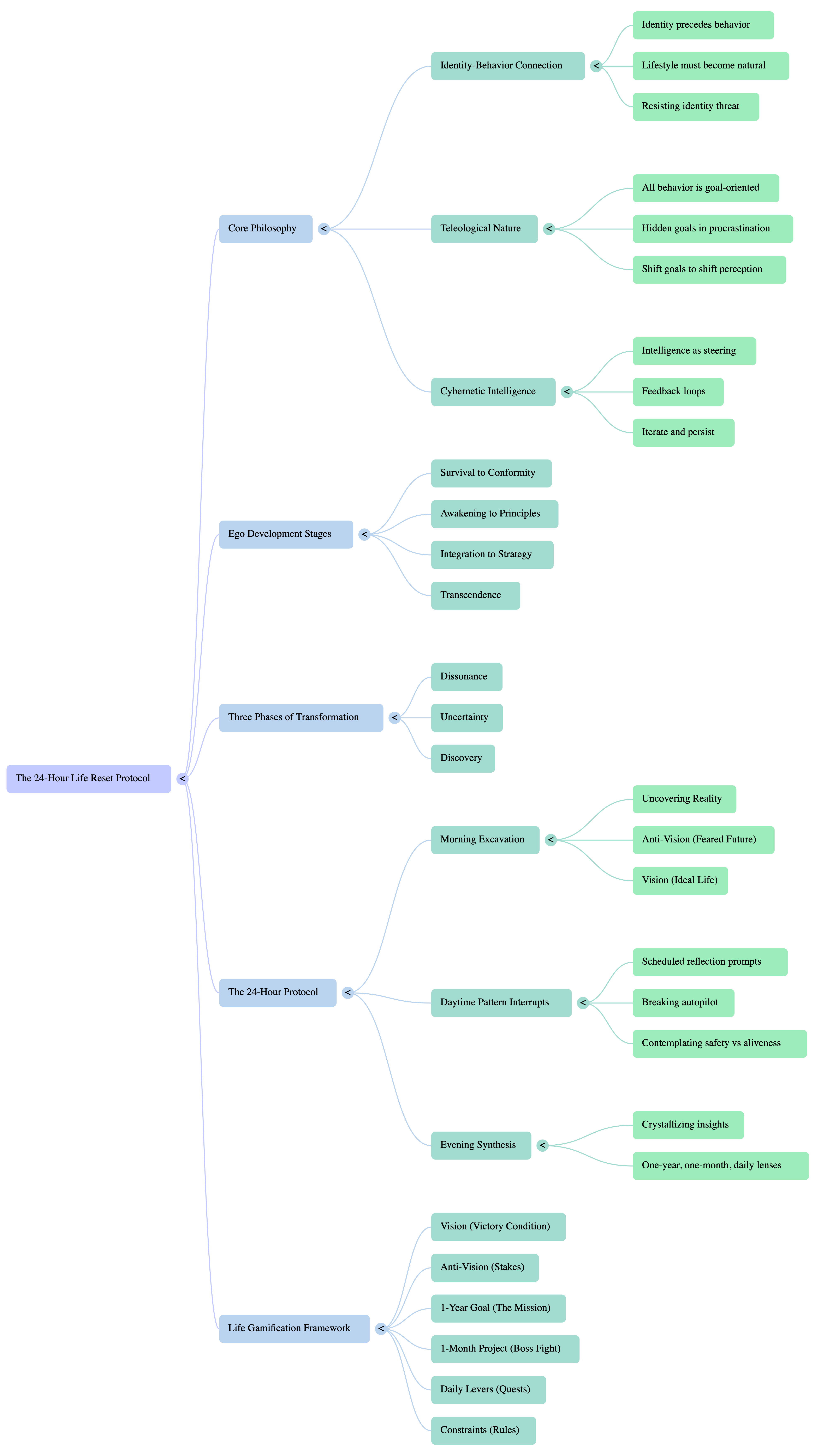
Complete Framework Mind Map
A visual overview of the entire 24-Hour Life Reset Protocol
References & Further Reading
Psycho-Cybernetics by Maxwell Maltz
The foundational text on self-image psychology and the cybernetic nature of goal achievement
Flow by Mihaly Csikszentmihalyi
The definitive work on optimal experience and the conditions that create engagement
Ego Development by Jane Loevinger
The research behind stages of psychological development
Alfred Adler's Individual Psychology
The teleological approach to understanding human behavior and motivation
Naval Ravikant on Intelligence
Essays on redefining intelligence as the ability to get what you want from life